Session 3: Act III: the court
Objectives
- Understand the courtroom scene of Act III
- Analyse power and reputation
- Re-enact the scene in your own words
Warm-up
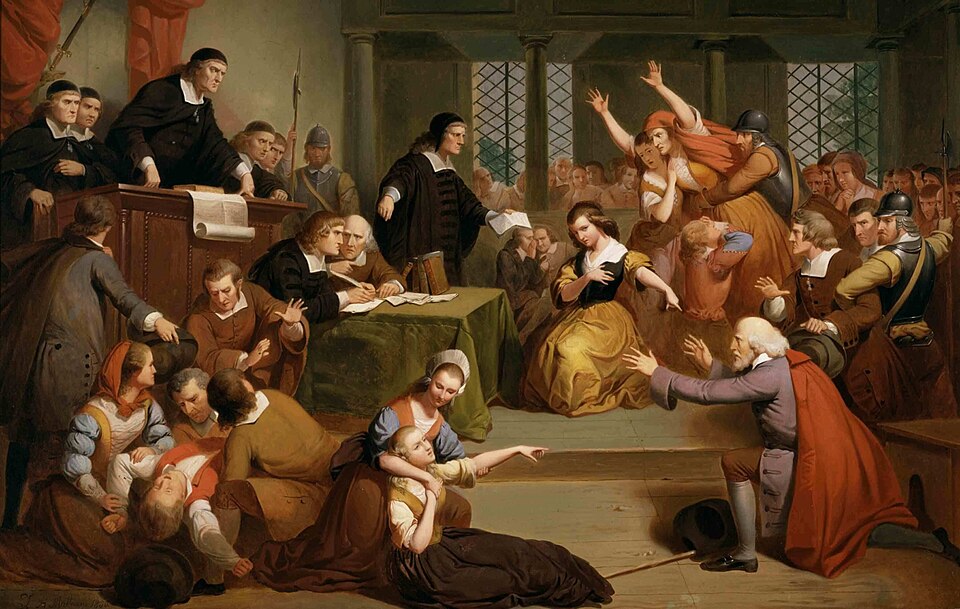
Students imagine a trial where the judge says: "If you are innocent, you have nothing to fear." Is this fair? Why or why not?
Documents
Arthur Miller, The Crucible, Act III, Mary Warren to Deputy Governor Danforth
Arthur Miller, The Crucible, Act III, Deputy Governor Danforth
Arthur Miller, The Crucible, Act III, Reverend Hale
Activities
- Read the three quotations. Who speaks? What does each one show about power in the court?
- Reputation: why does Elizabeth lie, and why is it tragic? Why will Danforth not admit he was wrong?
- Language of the court: Your Honour, I object, the evidence shows, I swear that, I beg you to.
- Intermediary task (interaction): re-enact the courtroom scene in your own words, not Miller's.
More activities
Close reading: Proctor in court
Proctor's outburst at the end of Act III.
Arthur Miller, The Crucible, Act III, John Proctor
- Who is Proctor accusing in this speech? Only Danforth?
- What is the fire? What is Lucifer here?
- Why does Proctor include himself ("it is my face")?
- What is the consequence of this speech for him?
- Proctor uses the image of fire to...
- By saying 'my face', he admits...
- This speech marks a turning point because...
Close reading: Danforth
Compare the two Danforth quotations.
Arthur Miller, The Crucible, Act III, Deputy Governor Danforth
- What does Danforth trust? What evidence does he accept?
- Why can he not admit that the children are deceiving him?
- Is Danforth a villain, or a man trapped by his own authority? Justify.
- Danforth trusts... because...
- If he admitted the truth, he would...
- In my view, Danforth is... since...
Sentence starters
- Your Honour, I swear that...
- The evidence shows that...
- How can you be sure that...?
- If you hang these people,...
- I beg the court to...
Role play
Groups of four: Danforth, Proctor, Mary Warren and Abigail. Mary tries to tell the truth, Proctor supports her, Abigail turns the court against her, Danforth must decide. Play it in modern English, then swap roles.
Gap-fill worksheet

- Mary Warren says the girls were ______.
- Danforth refuses to doubt the ______.
- Proctor decides to ______ his affair.
- He wants to destroy Abigail's ______.
- Elizabeth lies to protect her husband's ______.
- Hale says private vengeance is working through this ______.
- In Salem, it is impossible to prove your ______.
- Danforth treats every doubt as ______ of court.
Answer key
- pretending
- court
- confess
- credibility
- reputation
- testimony
- innocence
- contempt
Homework
Write Danforth's private letter to the governor (150 words): what happened in court today and why he will not stop the trials.
Watch the film at home
The Crucible (1996), directed by Nicholas Hytner. In France, the film is called La Chasse aux sorcières.
- Where to watch: see the list of streaming and rental options on JustWatch France.
- DVD: ask at your local library or médiathèque.
- Official trailer: on the Apple TV page of the film.
- Scenes to watch: Act I: the girls dance in the forest at night (the opening of the film). Act II: the officers arrest Elizabeth at home. Act III: in court, the girls turn against Mary Warren. Act IV: Proctor tears his confession and walks to the gallows.
Watch with English subtitles if you can.
Assessment grid
| Criteria | Level 1 | Level 2 | Level 3 | Level 4 |
|---|---|---|---|---|
| Understanding of the scene | Misreads | Partial | Accurate | Accurate and nuanced |
| Own words | Copies the text | Some own words | Own words | Own words, lively and precise |
| Interaction | Rarely reacts | Reacts simply | Reacts and argues | Reacts, argues and persuades |
| Pronunciation | Hard to understand | Understandable | Clear | Clear and expressive |
Terminale LV1 · C1/C2 extension track
For strong or anglophone students. Power in the courtroom: logic turned against the accused.
Extended extract
Increase Mather, Cases of Conscience, 1693 (public domain)
Critical analysis
- Explain the principle stated here.
- How does the court in the play break this principle?
- Why is it impossible to prove innocence in Act III?
Nuanced vocabulary
| Word or phrase | Meaning and use |
|---|---|
| presumption of innocence | the principle that one is innocent until proven guilty |
| burden of proof | the duty to prove a claim |
| due process | fair legal procedure |
| arguably | to present a view as defensible but open to debate |
| to hinge on | to depend entirely on |